Subject hub · inclusion, equity, identity
Equity and inclusion: the definitions decide the evidence
This is the subject area where argument most often stalls on undeclared definitions. Separating the questions makes the evidence usable: placement, resourcing, attainment and belonging are four claims, not one.
Published · subject hub
Two questions that get merged
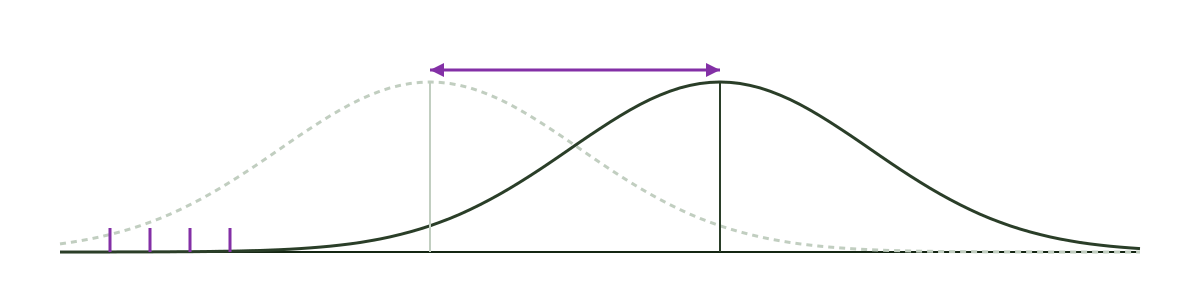
Almost every stalled argument in this area is two questions being answered as one. The first is distributive: who gets what (which schools, which teachers, which funding, which curriculum). The second is relational: whether a learner is treated as a full member of the setting they are in. They are related and they are not the same, and evidence about one is routinely offered as evidence about the other.
The distinction has practical consequences. A well-resourced setting can be relationally exclusionary, and a warm, welcoming setting can be materially starved. A programme that improves one and is evaluated on the other will look like a failure or a success for the wrong reason. Stating which question is being addressed is the cheapest available improvement to work in this area.
Inclusive education: the placement debate
The debate over placement of learners with disabilities is often conducted as though the evidence were one-sided in whichever direction the speaker prefers. What the research supports is narrower and more useful: outcomes depend far more on what is provided in a setting than on which setting it is. Mainstream placement with specialist support, adapted materials and trained staff produces good outcomes; mainstream placement as a cost-saving measure without those things does not, and the label on the placement is identical in both cases.
This is why "does inclusion work?" is close to unanswerable as posed, and why the productive version is: what has to be present for this learner in this setting, and is it funded? That question can be answered, audited and argued about with a budget in hand.
Two further points are reasonably well established. Peer effects run in both directions and are mediated by how the setting handles difference rather than by proximity alone. And teacher preparation is the variable most consistently associated with successful inclusive practice, which puts this hub's argument inside the teacher development brief rather than beside it.
Attainment gaps and what they measure
A gap statistic is a difference between two group averages on one measure at one point, and it is worth stating what that does and does not tell you.
It tells you that a difference exists and roughly how large. It does not tell you where the difference was produced, and this is the error with the largest practical cost: gaps present at school entry are frequently reported as evidence about schools. It does not tell you whether the gap is widening or narrowing, which requires the same cohort measured twice. And a gap can close because the lower group improved or because the higher group declined; the statistic reads the same either way, and the two situations call for opposite responses.
Composite measures deserve particular care. Free-school-meal eligibility, postcode-based indices and similar proxies are administratively convenient and correlate imperfectly with what they stand in for, so a finding stated in terms of a proxy should be read as a finding about the proxy.
Identity, belonging and the hidden curriculum
The relational question has its own literature, and its central claim is that a curriculum teaches things it never states: whose experience appears as normal, whose as exceptional, who is addressed as a future practitioner of the subject. This is not measurable in the way an attainment gap is, and it is not therefore unevidenced: the evidence is textual and observational, and it is judged by the standards appropriate to that kind of work.
Two findings from this strand transfer well into design. Representation in materials functions as information about who the subject is for, and learners read it as such whether or not it was intended. And the response to difference that a setting models (how a disagreement, an accent, a disability or an accusation is handled in front of everybody) teaches more reliably than any policy document about respect.
Work in this area is also where arts-based methods earn their place most clearly, because the object of study is experience and perspective rather than frequency. The standards for judging that work are in the arts-based research brief.
Language, and the cost of getting it wrong
Language is the equity variable most likely to be misread as ability, and the misreading is expensive because it is administratively invisible. A learner working in a second language is spending capacity on comprehension that a first-language peer spends on the task, which depresses performance on any assessment delivered in that language regardless of what the assessment claims to measure.
Two distinctions from this literature do real work. The first is between the conversational fluency that arrives comparatively quickly and the academic register — the vocabulary and syntax of written subject discourse — that takes considerably longer; a learner who sounds fluent can still be years from reading a textbook comfortably, and the mismatch is routinely mistaken for lack of effort. The second is between a language difference and a learning difficulty. Confusing them runs in both directions: second-language learners are over-referred to special provision in some systems and under-referred in others, and both errors follow from assessing in the language being learned.
The design responses are unremarkable and effective: assess the construct rather than the language where the two can be separated, teach the academic register explicitly as content, and treat the first language as a resource for building concepts rather than as an obstacle to be replaced. Multilingual classrooms are also where the relational question from the top of this page becomes concrete: whether a learner's own language appears in the room as an asset or as a problem is information they receive immediately.
Reading a claim about equity
- Distributive or relational? Name which question the claim answers before assessing its evidence.
- Where was the difference produced? A gap measured at school does not establish that school produced it.
- Same cohort or same age group? Only the first supports a claim about widening or narrowing.
- Is the group definition a proxy? If so, the finding is about the proxy, and the gap between proxy and reality belongs in the conclusion.
- Placement or provision? For inclusion claims specifically, this is almost always the substance of the disagreement.
Works referred to
- Access and Equity in Adult Education — Sense Publishers, 2011.
- Zero Tolerance and Other Plays: Disrupting Xenophobia, Racism and Homophobia in School — Sense Publishers, 2013.
- Gender Relations in Sport — Sense Publishers, 2013.
- Displacement, Identity and Belonging — Sense Publishers, 2015.
- Leadership for Inclusion: A Practical Guide — Sense Publishers, 2011.
- Free Women / Mujeres Libres: Anarchism and the Struggle for the Emancipation of Women — held in this domain's catalogue.
Questions readers send
Does inclusive education work?
As posed, the question is close to unanswerable, because placement and provision are being asked about at once. What the evidence supports is that outcomes depend on what is provided (specialist support, adapted materials, trained staff) far more than on which room the learner is in.
What does an attainment gap actually tell you?
That two group averages differ on one measure at one moment. It does not tell you where the difference was produced, whether it is widening, or which group moved, and gaps present at school entry are routinely reported as evidence about schools.
Is free-school-meal eligibility a good measure of disadvantage?
It is a convenient proxy that correlates imperfectly with what it stands for, so a finding stated in those terms is a finding about the proxy. The honest treatment is to say so in the conclusion rather than in a footnote.
How can a school tell whether it is relationally inclusive?
By looking at what it models rather than what it states. How a disagreement, an accent, a disability or an accusation is handled in front of everybody teaches more than a policy document, and it is observable without a survey.
Should a second-language learner be assessed in that language?
Only when the language is the construct being assessed. Otherwise the assessment measures comprehension load as well as the subject, which depresses the score for reasons that have nothing to do with what the test claims to measure.
The briefs that cover this in depth
- Adult education What adult education research supports and what it only asserts: the six andragogical assumptions checked one at a time, plus the participation evidence.
- Curriculum design Backward design, spiral sequencing and constructive alignment explained as a coverage-versus-depth trade, with the cost of each choice stated in teaching hours.
- Arts-based research Arts-based research assessed by one test: does the form do analytic work a table could not? Four checks and a worked example.