The Pedagogy Review

Education research explained, in the order the evidence builds

Six briefs, one sequence. Each rung assumes the one below it, so you can stop at the depth you need instead of reading six introductions that repeat each other.

Education research, in a reading sequence

Revised

This is education research explained for people who have to act on it: six standing briefs, each answering one question from its sources, each revised when the evidence moves rather than replaced by a newer article on the same topic.

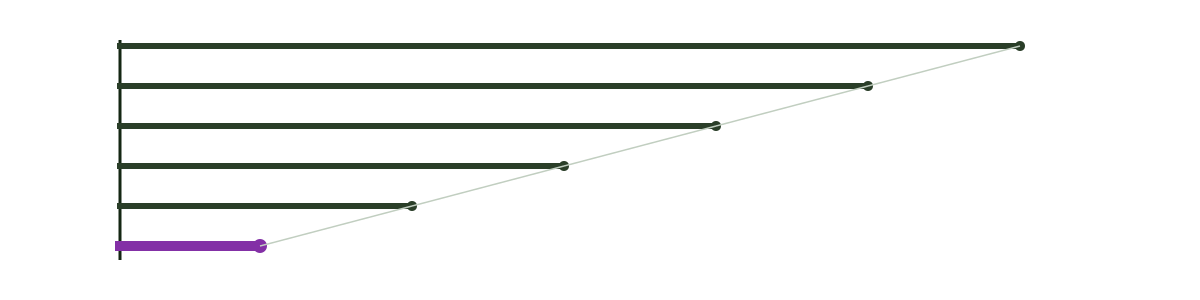
Six rungs on a single rail, each reaching further to the right than the one below it, with the lowest rung drawn heaviest. A thin line runs from the end of each rung to the end of the next, so the sequence reads as one climb rather than six separate items.
The sequence, and why it is one. The bottom rung is the vocabulary the five above it use.

Ground floor · vocabulary

Learning theories compared and explained

Behaviourist, cognitivist, constructivist and situated accounts, set side by side on the same questions: what counts as learning, what counts as evidence of it, and which classroom decisions each one licenses. Every later brief on this site uses this vocabulary, so it comes first.

  • Constructivism
  • Cognitive load
  • Situated learning
  • Transfer
Depth
Foundational
Read
12 min

First floor · the adult case

Adult education and andragogy: what the evidence supports

Andragogy is quoted in nearly every corporate training deck and tested in far fewer studies. Three of its six assumptions hold up, two are contested, one is a value statement wearing a finding's clothes, and the difference decides whether learner control helps or hurts your course.

  • Andragogy
  • Self-directed learning
  • Transformative learning
  • Provision
Depth
Core
Read
18 min

First floor · design

Curriculum design principles and backward design

Backward design, spiral sequencing and constructive alignment stated as costs rather than slogans: every hour of coverage is an hour not spent on depth, and the sequence you pick decides which one you are buying.

  • Backward design
  • Alignment
  • Spiral
  • Assessment
Depth
Core
Read
14 min
The useful question is never “does it work” but “compared to what, for whom, and at what cost to the rest of the syllabus”.
How these briefs are written

Second floor · the profession

Effective teacher professional development: the evidence

The effect of professional development on practice is real, modest, and decays. This brief separates the formats that keep working from the ones that keep getting funded, and states what a school can expect from each.

  • Coaching
  • Lesson study
  • Induction
  • Retention
Depth
Applied
Read
16 min

Second floor · doing research

How to write a dissertation: structure and supervision

The four failure modes behind most late-stage doctoral trouble are structural, not motivational: a question that cannot be answered with the method, a literature review written as a list, a findings chapter that argues, and a supervision rhythm nobody agreed on.

  • Question framing
  • Literature review
  • Supervision
  • Viva
Depth
Applied
Read
21 min

Top floor · the edge of the field

Arts-based research methods and rigour

Fiction, performance and image can carry findings that a table cannot, and can also hide the absence of any. The test is whether the form does analytic work, and this brief gives four ways to check.

  • Social fictions
  • Ethnodrama
  • Visual methods
  • Rigour
Depth
Specialist
Read
13 min

Three subject hubs

Where the old catalogue's subjects live now

Questions readers send

Where should I start?

With learning theories, even if it is not the subject you came for. It sets the vocabulary the other five briefs use, and the whole point of the sequence is that each rung assumes the one below it.

Why only six briefs?

Because a page per question, kept current, is more useful than a large archive that ages. Six is what can be revised properly when the evidence moves; a seventh would be added when there is a question we can answer to the same standard.

Are these updated, or is this a snapshot?

Revised in place. Each brief carries the date its argument last changed rather than a publication date, and what changed is recorded in the revision log.

Who is this written for?

People who have to act on education research (course designers, teachers, doctoral candidates, programme managers) rather than for the literature. Questions that are only interesting inside the literature are left there.

What if a brief is wrong?

Write to [email protected] with the sentence and why it does not hold. A specific objection with a source attached changes the page and is recorded in the revision log; the correction is made in place and noted rather than edited in quietly.

How each brief is explained, and what the evidence has to carry

What this is

Six standing briefs on education research, revised when the literature moves. Not a news feed and not a course catalogue.

How it is written

Sources cited inline, disagreements kept in, and an explicit note wherever the evidence is thin enough that practice should not lean on it. Education research explained honestly has to include the places where it does not yet know.

Who writes it

An editorial team, unsigned by design. Where a work is named it is because an argument needed it.